
Naturally Reared Carolina Dog puppies for homes committed to a Natural Rearing Lifestyle. Please explore my website for additional information.
About Nature's Way Carolina Dogs

- Susan Lewelling, Nature's Way Carolina Dogs
- Seymour, Tennessee, United States
- Welcome to my site about my Naturally Reared Carolina Dogs! Carolina Dogs are a relatively new, rare breed recognized by the UKC, AKC-FSS & ARBA, and are quite possibly America's own indigenous wild dog. CDs make wonderful companions, athletes, hunters, and bedwarmers! Natural Rearing is the philosophy wherein we raise our dogs and puppies by following the 8 Laws of Health, employing Biologically Appropriate Raw Food and no toxic chemicals on, in or around our dogs. We have found this way of life fosters balance, health and longevity in our beloved companions. For our puppies, we welcome homes that have a very similar philosophy about dog rearing, or wish to learn. Check us out, follow us and share us in other places!!! YouTube@ Susan NaturesWayCarolina Dogs NaturesWayPets and FaceBook @ https://www.facebook.com/mycarolinadog on Twitter @https://twitter.com/NaturesWayCDs Thank you so much for visiting our site, feel free to leave us a comment or send us an email! susanlewelling@yahoo.com
Wednesday, October 31, 2012

Tuesday, October 23, 2012
Dog Owners Need a Shark!
I just want to say that ANYONE that owns a dog (or especially more than one) needs a SHARK 2 in 1 Vac-then-Steam. I do not get any money or other considerations for promoting this product. I just believe in passing on tips that work.
This thing is GREAT! it is easy to use, lightweight, plenty strong & durable. I am not easy on any appliances or tools I own, so if something makes it at my house, it is truly a good product! It does great at vacuuming and switches quickly & easily over to the steam cleaner option. It has gotten my kitchen floor cleaner than it has been in years and without the use of toxic chemicals, actually with only water!
the only con I have found is that it dont have good suction unless it is flat on the floor. If it is flat, it does pick up even somewhat large/heavy objects like pebbles and candy wrappers, dirt clods etc.
Here is link to the Shark site and the specific product I have: http://www.sharkclean.com/Shark-MV2010-Vac-Then-Steam/ . I got mine at Wal-mart and I think I paid less than it is listed on this site, I think I paid about $129.00.
This thing is GREAT! it is easy to use, lightweight, plenty strong & durable. I am not easy on any appliances or tools I own, so if something makes it at my house, it is truly a good product! It does great at vacuuming and switches quickly & easily over to the steam cleaner option. It has gotten my kitchen floor cleaner than it has been in years and without the use of toxic chemicals, actually with only water!
the only con I have found is that it dont have good suction unless it is flat on the floor. If it is flat, it does pick up even somewhat large/heavy objects like pebbles and candy wrappers, dirt clods etc.
Here is link to the Shark site and the specific product I have: http://www.sharkclean.com/Shark-MV2010-Vac-Then-Steam/ . I got mine at Wal-mart and I think I paid less than it is listed on this site, I think I paid about $129.00.
Thursday, October 18, 2012
Fall 2012
Fall 2012 is shaping up to be a busy time for us at East Tennessee Dingos.
All the puppies have moved on to wonderful new homes and we are contemplating a litter for Early Spring 2013. Our objective for this litter is for a puppy to keep for ourselves. A second generation, Naturally Reared Carolina Dog for the future. If you are interested in a healthy, happy, family raised puppy from this litter, please email me a completed 'application' ASAP, or if you have already been approved let me know you want to make a reservation and send in your deposit. I do not breed without several committed homes for the puppies (more than verbal is needed), so this is essential. My deadlines for commitments is December 10th.
In the meantime, we are making improvements around our little homestead. We have our driveway in now and are working on more grade work, positioning buildings, planning future projects(garden, shed/lean-to, kennel for rescues, home additions, and more) figuring out where we will need gates and the like so we can get our fencing up. We have some inside work to do on the dog's bedroom. With our first litter we learned several things about raising puppies in the house (versus out in a kennel) one being that the walls need to be of a material that is more durable! We are going to be busy through next spring!
After years of dreaming and waiting for the right time (and the money), I am going to be starting classes to further my education! This will take awhile, but I hope to end up certified and qualified as a Small Animal Naturopathy Consultant/ Natural Animal Health Coach and Certified Natural Rearing Breeder. This is a field I am already passionate about and research daily. I hope to expand my knowledge and ability to help my dogs achieve "healthy wild" as well as to assist others to enhance their pet's health.
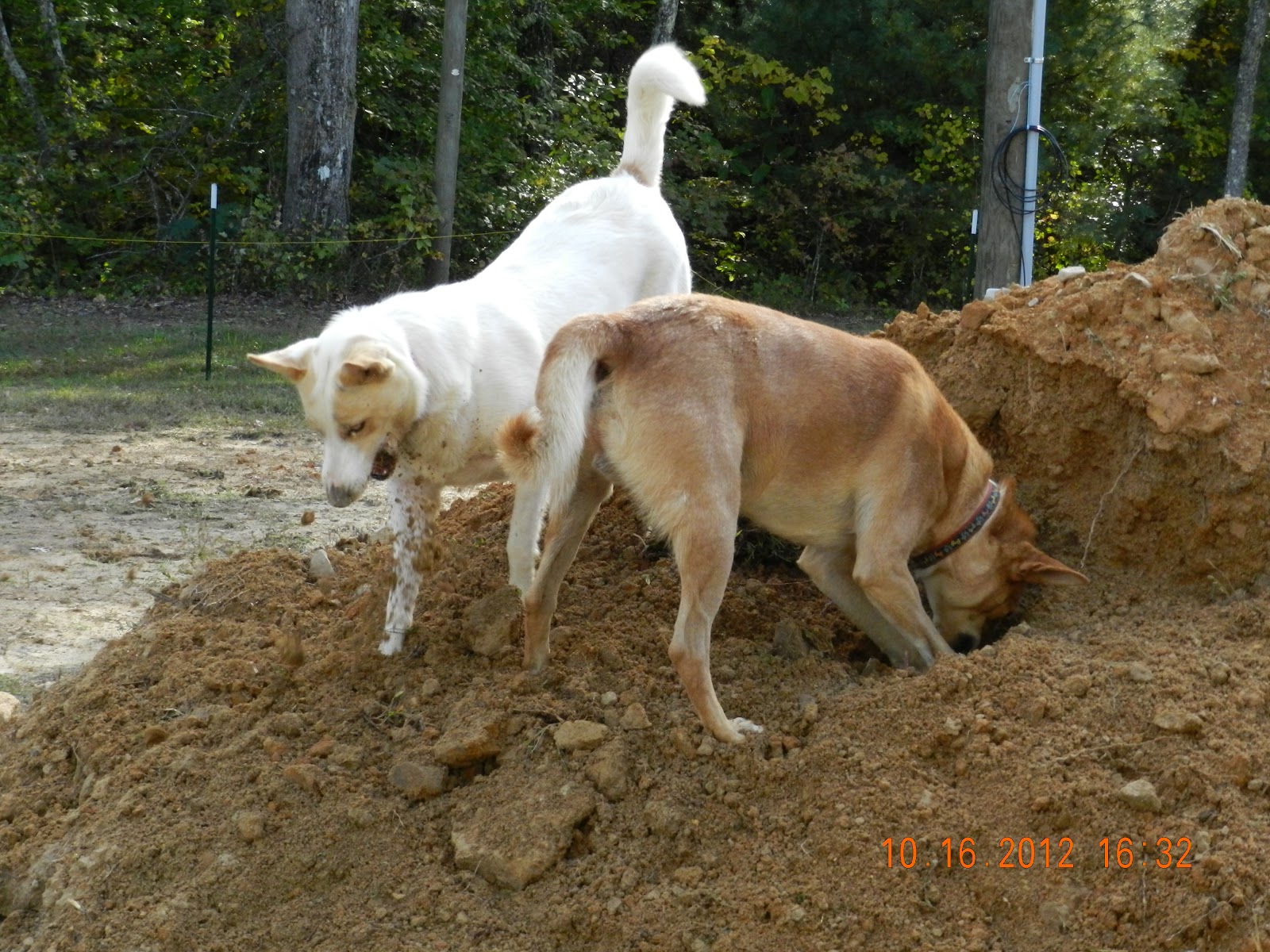
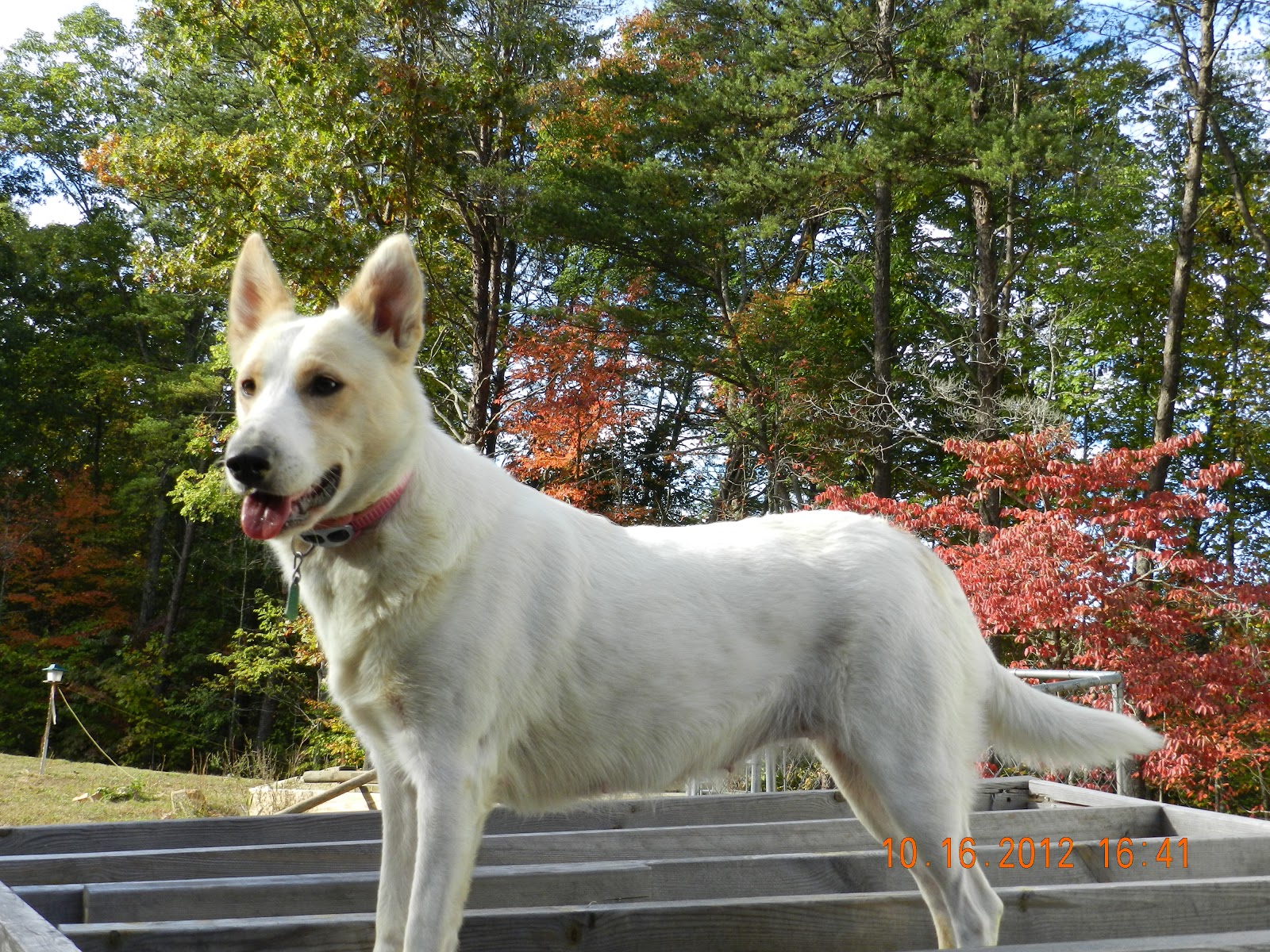
Here are some recent pictures of Cooter and Daisy. They seem to think that all this construction has been to create new play areas for them! Enjoy!
Here are some recent pictures of Cooter and Daisy. They seem to think that all this construction has been to create new play areas for them! Enjoy!




Wednesday, October 10, 2012
Carolina Dog Breed Standard.
Transposed from American Rare Breed Association website
CAROLINA DOG
Official U.K.C. Breed Standard*
Sighthounds Group
© Copyright 1996, United Kennel Club, Inc.
HISTORY
When the first primitive humans crossed the Bering landbridge into North America from Asia, they were accompanied by a primitive form of dogs that resulted from the domestication of southwest Asian wolves in the region of Iraq a few thousand years earlier.
These small, nondescript dogs moved quickly with their human companions down through the western part of North America. Skeletal remains and mummified bodies of these dogs have been found along with the artifacts of the Basket Maker culture of the primitive Southwest Indians. From here, these primitive dogs moved into the eastern United States. Archeological investigations have documented ceremonial burials of these dogs, an indication their presence in the southeastern forested woodlands as companions of the Indians of that region, long before the arrival of the white man on this continent.
Recently, studies of the free-ranging dogs of certain regions of South Carolina and Georgia have disclosed the continuing existence of small primitive dogs whose appearance, as well as behavior and general ecology, suggest a close ancestry (if not direct descent) of type from those first primitive dogs. Called the "Carolina Dog," these animals most closely resemble the Dingo of Australia, which may indeed be among their closest living relatives. The striking resemblance between these dogs and the Dingo, half a world apart, is likely due to the way in which both animals have filled a free-living, or as it is known-pariah, niche on the fringe of human civilization and culture.
The Carolina Dog was recognized by the United Kennel Club on January 1, 1995.
GENERAL APPEARANCE
The Carolina Dog is a dog of medium build, possessing the general appearance of a small jackal or wolf in combination with many features of a small Sighthound. The distinctive features of the breed are those which confer survival advantages under free-living conditions in tallgrass savannah and bottomland swamp forest habitats of the southeastern United States. The dog typically has a medium-length straight back, with a distinctive waist which sets-off a deep brisket from a highly tucked-up loin. The tail is distinctive in both its fish-hook-like configuration and its variable carriage, depending on mood. The large, upright ears and long, graceful neck are also distinctive and suggest the appearance of a small, versatile and resourceful predator well-adapted to surviving on its own in a natural habitat. In ideal conditions, a Carolina should appear thin and "tight." It is permissable, for example, for the ribs to show slightly as in a well-conditioned racing sighthound. Individuals that are greatly overweight should be severely penalized. The dog is to be shown in a natural condition, with little or no evidence of grooming or scissoring. Whiskers are not to be removed.
CHARACTERISTICS
A generally shy and suspicious nature may be characteristic, but excessive fear and any resistance to examination is not desirable.
Very serious fault - Outward aggression.
HEAD & SKULL
The skull is strong and impressive. It is broad between the ears and moderately rounded, and has ample muscle. There is a distinct furrow extending down between the eyes. The forehead is slightly rounded. There is a distinct occiput. The stop is slight, but distinct. Younger dogs often show a distinctive, fine wrinkling on the forehead, giving a frown effect.
Viewed from above, the head forms a wide triangle; the tapering of the muzzle being accentuated by the highly-developed jaw muscles.
The skull tapers to a strong, distinctively pointed muzzle. The length of the muzzle is approximately equal to the length of the cranial portion of the skull. The jaws are powerful, clean and deep. The tight-fitting lips are predominately black.
TEETH
A full complement of white, well-developed, even teeth meet in a scissors or level bite.
Serious faults - Undershot bite. Overshot bite.
EYES
The almond-shaped eyes are dark brown in color. They are set obliquely. Eye rims are black and unbroken. Overall expression is one of softness and intelligence, but highly cautious. Blue or orange flacks in eyes are permitted. Blue eyes are a minor fault.
NOSE
The nose is black and has large, well-opened nostrils. Minor faults - Liver-colored nose. Dudley nose. Butterfly nose.
EARS
The ears are distinctive and expressive, and versatile in carriage. They are slightly rounded at the tip, and fine in texture. The ideal ear is shaped like an equilateral triangle, although the base may be slightly shorter than the ascending edges. They are carried erect when alerted, but can be folded carried back along the neck. The ears are set well on top of the head, slightly pointing forward. Ear placement is more important than size, but it is essential that they be forward-pointed and set on top of the head.
A characteristic position is for one ear to be firmly pricked, and the other to rotate sensitively to pick up sounds.
Semi-prick ears are permitted, but are to be penalized according to the degree of deviation from a full, upright configuration. Drop ears are a major fault.
TONGUE
Solid pink. Dark spots or pigmentation on tongue is a disqualification.
NECK
The neck is notable in its strength and development. It is strongly crested, fitting well into the shoulders, thus accentuating the crest to give the head a lofty carriage. The neck is graceful and swanlike, yet muscular and well-arched, providing the animal with a means of making rapid and effective downward stabbing movements with the head when hunting in tall grass.
Serious faults - Short neck. Throaty neck.
FOREQUARTERS
The long shoulders are laid back.
FORELEGS
The forelegs are straight. The forearms have good length, moderate bone and distinctive musculature. The moderately straight, flexible pasterns are of good length.
BODY
The chest cavity is well-sprung, and is deep, with plenty of lung and heart room. The chest is narrow-to-medium in width. The deep brisket reaches to the elbows in mature specimens. The deep brisket ends in a definite waist with a well-defined tuckup. The back is strong and straight. It may be moderately long, but must have no suggestion of slackness. There is a slight rise over the loin.
HINDQUARTERS
The hindquarters are strong, powerful and muscular. They are set under the body. They are well-angulated and exhibit tremendous drive and agility, enabling the dog to turn quickly while moving forward. The hindquarters are parallel when in full gait.
HIND LEGS
The thighs are thick, strong and well-muscled, almost as in a well-conditioned racing sighthound. Dewclaws are not desirable.
FEET
While standing, the forefeet may be slightly turned out, but equally so. The moderately small feet are compact, never splayed. The toes are well-arched. The pads are hard. The nails are strong.
TAIL
Like the ears, the tail is a most expressive and characteristic feature of this breed. It is set on as a continuation of the spine. It has a moderate brush, but is most heavily haired on the underside, which is light-colored or at least paler than the upper surface, which may show some dark sabling.
When the dog is alert, the tail is held in a characteristic "fish hook" carriage, usually at about a 45-degree angle from the horizontal. When the dog is gaiting at a trot, the tail is usually carried in a downward "pump handle" configuration. At other times, especially when the dog is being approached by stranger, the tail may be held low or tucked between the rear legs, but it must never be slack or loose in its hang.
Serious faults - Any tail which twists, curls or in a tight roll over the back
COAT & SKIN
This is a distinguishing feature of the breed. Its appearance is affected by the seasons. The winter coat is distinctly heavier than the summer coat. In the cooler months, there should be a wealth of undercoat. Animals showing shedding at appropriate times of the year are not to be penalized.
On the head, the ears, and front legs, the hair is short and smooth. Coarse, longer guard hairs (longer than the undercoat) extend over the neck, withers and back. When aroused, this hair stands erect. The coat behind the shoulder blades is often lighter in color.
The skin is pliant, but not flabby or loose.
Faults -Long, curly, wavy, or broken coats.
COLOR
Preferred color: a deep red ginger with pale buff mark-ings over the shoulders and along the muzzle. Acceptable colors: variations in color, grading from straw-colored through wheaten to pale cream buff
The preferred and acceptable colors usually include lighter colors on the underside, chest and throat, sometimes being nearly white on the throat. Some white on the toes is common and not to be penalized. Dark sabling over the back, loins and tail is permissible. Dogs less than two years of age often have all-black muzzles, but this is not required.
The following color patterns are permitted: piebald spotting; and black blanket back.
HEIGHT & WEIGHT
The average height, measured at the withers, generally ranges from 17 to 24 inches, but can vary according to build. Type and symmetry are more important than size. Weight is dependent on the overall size and build of the individual, and varies from approximately 30 to 55 pounds.
Bitches are generally lighter in build than dogs, but the sexes overlap broadly in both size and weight. At no time should the breed appear heavy-bodied.
GAIT & MOVEMENT
Gait is low, free-moving, effortless and smooth. There is a suggestion of flexibility in the back, as would be expected for a small sighthound capable of a double suspension gallop.
Serious faults - High, choppy, or hackneyed gaits. Toeing-in. Toeing-out. Moving too close behind.
DISQUALIFICATIONS Viciousness or extreme shyness. Unilateral or bilateral cryptorchid.
When the first primitive humans crossed the Bering landbridge into North America from Asia, they were accompanied by a primitive form of dogs that resulted from the domestication of southwest Asian wolves in the region of Iraq a few thousand years earlier.
These small, nondescript dogs moved quickly with their human companions down through the western part of North America. Skeletal remains and mummified bodies of these dogs have been found along with the artifacts of the Basket Maker culture of the primitive Southwest Indians. From here, these primitive dogs moved into the eastern United States. Archeological investigations have documented ceremonial burials of these dogs, an indication their presence in the southeastern forested woodlands as companions of the Indians of that region, long before the arrival of the white man on this continent.
Recently, studies of the free-ranging dogs of certain regions of South Carolina and Georgia have disclosed the continuing existence of small primitive dogs whose appearance, as well as behavior and general ecology, suggest a close ancestry (if not direct descent) of type from those first primitive dogs. Called the "Carolina Dog," these animals most closely resemble the Dingo of Australia, which may indeed be among their closest living relatives. The striking resemblance between these dogs and the Dingo, half a world apart, is likely due to the way in which both animals have filled a free-living, or as it is known-pariah, niche on the fringe of human civilization and culture.
The Carolina Dog was recognized by the United Kennel Club on January 1, 1995.
GENERAL APPEARANCE
The Carolina Dog is a dog of medium build, possessing the general appearance of a small jackal or wolf in combination with many features of a small Sighthound. The distinctive features of the breed are those which confer survival advantages under free-living conditions in tallgrass savannah and bottomland swamp forest habitats of the southeastern United States. The dog typically has a medium-length straight back, with a distinctive waist which sets-off a deep brisket from a highly tucked-up loin. The tail is distinctive in both its fish-hook-like configuration and its variable carriage, depending on mood. The large, upright ears and long, graceful neck are also distinctive and suggest the appearance of a small, versatile and resourceful predator well-adapted to surviving on its own in a natural habitat. In ideal conditions, a Carolina should appear thin and "tight." It is permissable, for example, for the ribs to show slightly as in a well-conditioned racing sighthound. Individuals that are greatly overweight should be severely penalized. The dog is to be shown in a natural condition, with little or no evidence of grooming or scissoring. Whiskers are not to be removed.
CHARACTERISTICS
A generally shy and suspicious nature may be characteristic, but excessive fear and any resistance to examination is not desirable.
Very serious fault - Outward aggression.
HEAD & SKULL
The skull is strong and impressive. It is broad between the ears and moderately rounded, and has ample muscle. There is a distinct furrow extending down between the eyes. The forehead is slightly rounded. There is a distinct occiput. The stop is slight, but distinct. Younger dogs often show a distinctive, fine wrinkling on the forehead, giving a frown effect.
Viewed from above, the head forms a wide triangle; the tapering of the muzzle being accentuated by the highly-developed jaw muscles.
The skull tapers to a strong, distinctively pointed muzzle. The length of the muzzle is approximately equal to the length of the cranial portion of the skull. The jaws are powerful, clean and deep. The tight-fitting lips are predominately black.
TEETH
A full complement of white, well-developed, even teeth meet in a scissors or level bite.
Serious faults - Undershot bite. Overshot bite.
EYES
The almond-shaped eyes are dark brown in color. They are set obliquely. Eye rims are black and unbroken. Overall expression is one of softness and intelligence, but highly cautious. Blue or orange flacks in eyes are permitted. Blue eyes are a minor fault.
NOSE
The nose is black and has large, well-opened nostrils. Minor faults - Liver-colored nose. Dudley nose. Butterfly nose.
EARS
The ears are distinctive and expressive, and versatile in carriage. They are slightly rounded at the tip, and fine in texture. The ideal ear is shaped like an equilateral triangle, although the base may be slightly shorter than the ascending edges. They are carried erect when alerted, but can be folded carried back along the neck. The ears are set well on top of the head, slightly pointing forward. Ear placement is more important than size, but it is essential that they be forward-pointed and set on top of the head.
A characteristic position is for one ear to be firmly pricked, and the other to rotate sensitively to pick up sounds.
Semi-prick ears are permitted, but are to be penalized according to the degree of deviation from a full, upright configuration. Drop ears are a major fault.
TONGUE
Solid pink. Dark spots or pigmentation on tongue is a disqualification.
NECK
The neck is notable in its strength and development. It is strongly crested, fitting well into the shoulders, thus accentuating the crest to give the head a lofty carriage. The neck is graceful and swanlike, yet muscular and well-arched, providing the animal with a means of making rapid and effective downward stabbing movements with the head when hunting in tall grass.
Serious faults - Short neck. Throaty neck.
FOREQUARTERS
The long shoulders are laid back.
FORELEGS
The forelegs are straight. The forearms have good length, moderate bone and distinctive musculature. The moderately straight, flexible pasterns are of good length.
BODY
The chest cavity is well-sprung, and is deep, with plenty of lung and heart room. The chest is narrow-to-medium in width. The deep brisket reaches to the elbows in mature specimens. The deep brisket ends in a definite waist with a well-defined tuckup. The back is strong and straight. It may be moderately long, but must have no suggestion of slackness. There is a slight rise over the loin.
HINDQUARTERS
The hindquarters are strong, powerful and muscular. They are set under the body. They are well-angulated and exhibit tremendous drive and agility, enabling the dog to turn quickly while moving forward. The hindquarters are parallel when in full gait.
HIND LEGS
The thighs are thick, strong and well-muscled, almost as in a well-conditioned racing sighthound. Dewclaws are not desirable.
FEET
While standing, the forefeet may be slightly turned out, but equally so. The moderately small feet are compact, never splayed. The toes are well-arched. The pads are hard. The nails are strong.
TAIL
Like the ears, the tail is a most expressive and characteristic feature of this breed. It is set on as a continuation of the spine. It has a moderate brush, but is most heavily haired on the underside, which is light-colored or at least paler than the upper surface, which may show some dark sabling.
When the dog is alert, the tail is held in a characteristic "fish hook" carriage, usually at about a 45-degree angle from the horizontal. When the dog is gaiting at a trot, the tail is usually carried in a downward "pump handle" configuration. At other times, especially when the dog is being approached by stranger, the tail may be held low or tucked between the rear legs, but it must never be slack or loose in its hang.
Serious faults - Any tail which twists, curls or in a tight roll over the back
COAT & SKIN
This is a distinguishing feature of the breed. Its appearance is affected by the seasons. The winter coat is distinctly heavier than the summer coat. In the cooler months, there should be a wealth of undercoat. Animals showing shedding at appropriate times of the year are not to be penalized.
On the head, the ears, and front legs, the hair is short and smooth. Coarse, longer guard hairs (longer than the undercoat) extend over the neck, withers and back. When aroused, this hair stands erect. The coat behind the shoulder blades is often lighter in color.
The skin is pliant, but not flabby or loose.
Faults -Long, curly, wavy, or broken coats.
COLOR
Preferred color: a deep red ginger with pale buff mark-ings over the shoulders and along the muzzle. Acceptable colors: variations in color, grading from straw-colored through wheaten to pale cream buff
The preferred and acceptable colors usually include lighter colors on the underside, chest and throat, sometimes being nearly white on the throat. Some white on the toes is common and not to be penalized. Dark sabling over the back, loins and tail is permissible. Dogs less than two years of age often have all-black muzzles, but this is not required.
The following color patterns are permitted: piebald spotting; and black blanket back.
HEIGHT & WEIGHT
The average height, measured at the withers, generally ranges from 17 to 24 inches, but can vary according to build. Type and symmetry are more important than size. Weight is dependent on the overall size and build of the individual, and varies from approximately 30 to 55 pounds.
Bitches are generally lighter in build than dogs, but the sexes overlap broadly in both size and weight. At no time should the breed appear heavy-bodied.
GAIT & MOVEMENT
Gait is low, free-moving, effortless and smooth. There is a suggestion of flexibility in the back, as would be expected for a small sighthound capable of a double suspension gallop.
Serious faults - High, choppy, or hackneyed gaits. Toeing-in. Toeing-out. Moving too close behind.
DISQUALIFICATIONS Viciousness or extreme shyness. Unilateral or bilateral cryptorchid.
Thursday, September 27, 2012
Current Rescues we are networking!
If you are interested in a Carolina Dog and want to help a rescue dog out, here is a place!
It is the Carolina Dog Type/LTPM Rescue Network and is found on Facebook at : https://www.facebook.com/groups/183684005020509/
I am currently an administrator of the page, along with several other wonderful CD owners. We do our best to informally identify Carolina Dog/LTPM types in need of a forever home and match them up with a CD- savvy person in need of some dingo kisses! We are not scientists, or experts, we are just CD lovers that have several years of experience working with CDs in different areas, rescuing, raising breeding, owning & loving! We find posting of shelter dogs around the country and if they seem to be of the CD type we network them as much as possible and try to find them homes. We also help new CD owners learn about these special dogs and their unique characteristics, training techniques, health issues, socialization, and the like!
Here are some dogs we are currently networking that are in need of a permanent home or of rescue/foster (at least).
It is the Carolina Dog Type/LTPM Rescue Network and is found on Facebook at : https://www.facebook.com/groups/183684005020509/
I am currently an administrator of the page, along with several other wonderful CD owners. We do our best to informally identify Carolina Dog/LTPM types in need of a forever home and match them up with a CD- savvy person in need of some dingo kisses! We are not scientists, or experts, we are just CD lovers that have several years of experience working with CDs in different areas, rescuing, raising breeding, owning & loving! We find posting of shelter dogs around the country and if they seem to be of the CD type we network them as much as possible and try to find them homes. We also help new CD owners learn about these special dogs and their unique characteristics, training techniques, health issues, socialization, and the like!
Here are some dogs we are currently networking that are in need of a permanent home or of rescue/foster (at least).


Wednesday, September 19, 2012
Tuesday, September 18, 2012
Is Your Dog Bored?
| |
| Your domesticated wolf in a civilized societyYou might think that you already do everything you can to satisfy your dog's most fundamental needs. You feed it, you give it water, you give it shelter - you take it to the vet when it is sick - all the TLC! So, your dog does not suffer! I hope you are right - but the argument above does not suffice for the conclusion! There are many other needs that matter a lot for the dog - needs that are impossible for it to satisfy on its own! Here are some examples: Meaningful social interaction with its pack? Is your dog getting enough of that? Most dogs need at least 6-8 hours of daily interaction with others... Hunting excitement? What about all the behaviors connected to hunting: tracking, chasing, fighting, killing! Does your dog experience any of those? Brain work? Are you challenging your dog to solve problems that are worthy problems for a dog to solve? Do you stimulate it to do nosework? OK - OK - OK - I see all the objections...! Using training and playFirst: Dogs can learn to be alone. It is not a natural thing for them. But learning that does take that the dog's social needs are generally satisfied - if not, you are in for a lot of trouble when you leave that dog alone! 6-8 hours of daily interaction is about the same you need to have with your family. It is not all about "partying" - but just the overall experience of "being together". Part of this time should be directly interactive. Half of it, probably. The rest can be "watching TV together" - which for the dog means "being in the same room". Second: Hunting is a problem for most people. You cannot just let your dog run around in the forest chasing deer. But you could teach it to use its nose for tracking, following your foots print to a piece of food at the end of the track. That would do the same thing, as far as instinct behavior goes. And it would be far more manageable. Chasing - ball play is a super substitute. Dogs don't care what they chase - their instincts are open for learning to chase whatever is rewarded. Make it a ball or a Frisbee, and your dog is happy. Fighting and Killing - don't be scared, you are not teaching your dog to be aggressive. Dogs do these things all the time when they play with each other. You just need to learn how to play with your dog - on the dog's terms, but with your rules! For the killing, you can use and old sock - they are good for tug-of-war games and for being "destroyed". And you can teach your dog to play-fight with you without its teeth ever touching your skin or your clothes! Brain stimulationDogs have a brain that needs to be used. A hunter, the dog has the capability of solving fairly complex problems - it is very open to constant learning. You need to make sure you always have some project going on that aims at teaching it something new. Retirement for a dog is mental death. Teaching your dog to use it nose, for instance for tracking or search, is a great way of satisfying many needs at the same time: nosework, hunting excitement, problem solving, learning new skills, interacting with you! Also: do teach your dog to work on a problem on its own when you do not have enough time right now to attend to its needs. There are many ways of giving the dog meaningful tasks to do that both stimulates the brain and taps into several of the hunting instincts. Instead of letting your dog destroy thing you value, you can wrap a treat into a cardboard box. Make some holes so the smell gets out - and let the dog "destroy" the box in order to get to the treat! Nobody gets killed, except the box - and the dog will have a great time. Once the dog "gets the hang of it", you can easily make it more difficult by use a Chinese box system with several boxes inside each other, and you can hide the box and let the dog search for it first. The possibilities are endless if you are willing to use a little imagination and keep an eye on the dog's fundamental instincts. The key is that, instead of "natural triggers" for the instincts you cannot really manage directly, you can use imitations. As long as they can trigger the behavior, they will serve the purpose of keeping the need behind those behaviors down at level that does not cause frustration - which means a mentally balanced dog in harmony with its family and environment. Sincerely, Mogens Eliasen
|

Wednesday, September 12, 2012
AVMA Policy to Discourage Raw Feeding... Common Sense?
AVMA voted in a new policy that strongly discourages anyone from feeding their pets a RAW meat diet, based upon the possibility of Salmonella contamination.
Please consider the following:
1. "Pet owners have been feeding raw diets to their dogs and cats for decades, yet to date, not one documented case of raw pet food causing illness in humans has been reported. Not one." *Dr Becker Article
2. "To date, there have been no published reports of salmonellosis occurring in dogs as a result of exposure to natural pet treats.” *Dr Becker Article
3. the MANY recent RECALLS of processed pet foods & treats, for SALMONELLA CONTAMINATION (as well as other reasons such as other pathogens, mold, toxic additives, etc) as recently as yesterday! see: Dog Food Recall- Salmonella
4. There are board members of the AVMA that are also board members of big kibble companies... conflict of interest there? I think so!
In light of this, many vets are going to wonder why more & more people do not trust their recommendations and the AVMA's recommendations, as we pet owners use our common sense and start to realize what is happening here, as we begin to do our own research and choose more natural products and ways of caring for our pets!
Thank you Dr Karen Becker for once again telling the truth clearly & concisely! Dr Becker Article
Wednesday, August 29, 2012
Susan's Homemade Pest Repellent for Pets
Ingredients

Directions
thinly slice orange & lemons, peel & all or peel only.
Variations
can include using: cedar oil, neem, Apple Cider Vinegar(organic with the "mother"), grapefruit peels.
1 quart water(well water or bottled, not tap/city water)
2 lemons
1 orange
few sprigs rosemary.
(please use organic or home-grown-non-pesticided ingredients!)

Directions
thinly slice orange & lemons, peel & all or peel only.
Add to water in a large saucepan/pot
bring to a rolling boil
Then cover & remove from heat.
Allow to steep in the pot in the refrigerator overnight .
strain with cheesecloth or something similar that will finely strain
Pour into a clean spray bottle.
Spray dog all over, including feet, until DAMP.
brush or rub in and allow dog to dry.
Repeat every week or two as needed.
Variations
can include using: cedar oil, neem, Apple Cider Vinegar(organic with the "mother"), grapefruit peels.
I know this base recipe works for us, and I usually try some new addition every batch or two.
I got this idea from Dr Pitcairn's Lemon Dip for fleas but I needed something that worked well on ticks too.
this has been very successful for us. You may need to use it more or less, or use more lemon, etc. to find the exact mixture that works for you.
I currently have 3 40-45 pound dogs that like to spend alot of time outside. One batch lasts us about a month.
this has been very successful for us. You may need to use it more or less, or use more lemon, etc. to find the exact mixture that works for you.
I currently have 3 40-45 pound dogs that like to spend alot of time outside. One batch lasts us about a month.
Help rescue a part of American History
This is a post via a wonderful volunteer at the shelter where Romeo & Juliet were brought in. We need help getting them to Dr Brisbin in South Carolina for his evaluation & study, as he is facing double knee replacement surgery and may not be able to drive himself there to pick up the pair. He is very excited about this pair, the ramifications of finding CDs in Louisiana and finding a cream & a red together(suggests possibly a larger pack -genetics- or broader range or migration than previously thought).
This is American History in the making, Carolina Dogs are possibly the United States' only aboriginal dog. Furthering Dr Brisbin's study can only help finding more about the Carolina Dog, and thus Early American Peoples. Please Chip In or volunteer to drive a leg if you are on the route! If you need more information, please send me an email asap & I can put you in touch with the right people.
 CHIP IN FOR RESCUE AND VET CARE OF ROMEO AND JULIET:
http://sherryg.chipin.com/romeo-and-juliet-carolina-dogs
click on link above for easy options.
"Romeo and Juliet are two wild, mated pair of Carolina Dogs that was picked up by Animal Control and is in our shelter in Port Allen, LA. Dr. Lehr Brisbin is wanting to bring these dogs up to South Carolina to his place. He is very excited about them and what this could mean to his studies and the fact that there has been no validated pockets of CD's coming from Louisiana.
Dr. Brisbin was planning on driving to get them himself but now because of knee surgery, it is looking like we are going to have to arrange transport, which we are going to need help with. Also Juliet's eyes are getting worse and she needs vet care. Our shelter is a very small shelter, with no in house vet so everything extra that is done for these animals comes from donations. If you could PLEASE help in any way we would APPRECIATE it. It is a 12 hour drive from Baton Rouge, LA to Akin, SC. If anyone would be able to PERSONALLY DRIVE any of these legs that would be appreciated.
Dr. Brisbin has said that anyone helping transport these dogs to him would be first in line for a free registered puppy. iIt wouldn't be so hard on one person if we could break this up. I would like to collect enough money to help with mileage and any vet care for these dogs. They may also need to be temporarily boarded as our shelter is in danger of becoming full because of hurricane evacuees animals that we are forced to take in. We have jumped through hoops getting these dogs approved for this trip to Dr. Brisbin, now we are just asking for help getting them there...thank you."
This is American History in the making, Carolina Dogs are possibly the United States' only aboriginal dog. Furthering Dr Brisbin's study can only help finding more about the Carolina Dog, and thus Early American Peoples. Please Chip In or volunteer to drive a leg if you are on the route! If you need more information, please send me an email asap & I can put you in touch with the right people.

http://sherryg.chipin.com/romeo-and-juliet-carolina-dogs
click on link above for easy options.
"Romeo and Juliet are two wild, mated pair of Carolina Dogs that was picked up by Animal Control and is in our shelter in Port Allen, LA. Dr. Lehr Brisbin is wanting to bring these dogs up to South Carolina to his place. He is very excited about them and what this could mean to his studies and the fact that there has been no validated pockets of CD's coming from Louisiana.
Dr. Brisbin was planning on driving to get them himself but now because of knee surgery, it is looking like we are going to have to arrange transport, which we are going to need help with. Also Juliet's eyes are getting worse and she needs vet care. Our shelter is a very small shelter, with no in house vet so everything extra that is done for these animals comes from donations. If you could PLEASE help in any way we would APPRECIATE it. It is a 12 hour drive from Baton Rouge, LA to Akin, SC. If anyone would be able to PERSONALLY DRIVE any of these legs that would be appreciated.
Dr. Brisbin has said that anyone helping transport these dogs to him would be first in line for a free registered puppy. iIt wouldn't be so hard on one person if we could break this up. I would like to collect enough money to help with mileage and any vet care for these dogs. They may also need to be temporarily boarded as our shelter is in danger of becoming full because of hurricane evacuees animals that we are forced to take in. We have jumped through hoops getting these dogs approved for this trip to Dr. Brisbin, now we are just asking for help getting them there...thank you."
Monday, August 27, 2012
Is Our Pet's Health Mirroring Human Health Today?
Our pets seem to be mirroring the same increase in symptoms & diseases that humans are having today; obesity, diabetes, cancer, immune system disorders, intestinal/digestive problems, chronic skin problems/infections. The vast majority of these pets are fed commercial pet food- the human equivalent of pre-packaged fast food/junk food and are being vaccinated way more than many experts know is necessary. What does this tell us about our own health?
Could we learn something from this parallel about our own health?
Sadly, some dogs are beyond help and must be humanely euthanized(such as the example I wrote about recently- Jack's Story - vaccines can be deadly or intensively managed to survive day to day, but the vast majority can be returned to more viable health by an immediate switch to healthy species appropriate raw foods, refraining from further unnecessary vaccinations(see this video for information ) and possibly detoxification help by an experienced Homeopath or Naturopath.
Of course you can help your pet to have a healthier life from the beginning by starting them out on a Natural diet as soon as you get them and refraining from use of toxins in/on/around your pets. One step further is thoughtfully choosing a pet that has been Naturally Reared and is from Naturally Reared parents.
Likewise we can positively affect our own health by choosing a healthier lifestyle; eat less processed foods, more whole foods, more organically grown foods, and decreasing our dependence on pharmaceutical medications & vaccinations to control illness symptoms in instances that we could heal ourselves via lifestyle & diet.
I'm pretty sure everyone has noticed that healthy living, use of organics, natural or homeopathic remedies, whole foods and similar measures is on the rise. This is a slow process, getting the mainstream of society to increase their use of these healthy habits, just as it is a slow process getting the veterinary establishment to learn about, accept, and promote a healthier lifestyle: whole fresh raw foods, less chemicals and minimal (and safer) vaccinations, for our pets. There have been changes, there is a glimmer of light on the horizon, Integrative Veterinary Medicine is on the rise, the Rabies Challenge Fund(http://www.rabieschallengefund.org/ ) is working hard to raise awareness and prove that Duration of Immunity in core vaccines is much longer than what has been "taught" in past years.
We that HAVE experienced the transformation in our pets, from surviving to thriving, we must continue to educate others, we must keep challenging the current status-quo of yearly vaccinations and the pushing of toxins & kibble as the only way. We have to continue to support our Naturopaths and Holistic & Integrative Vets, those that are willing to step out on a limb and question the mainstream for our pets health, not their bottom line, and we must continue to support organizations like the Rabies Challenge Fund.
Maybe along the way, pet owners will also learn more healthy ways for themselves and their human families. It has happened to me! Through my journey of learning about healthier ways for my dogs, I have become aware of healthier choices for myself and my family....What about you?
Saturday, August 25, 2012
Chemical Sensitivity in Mainstream Medical Documentation: The 80+ Chemical Ingredients in Febreze
PLEASE DO NOT USE FEBREZE!!!!! Read this for a list of TOXIC chemicals it contains & how they can affect you & your pets!
Chemical Sensitivity in Mainstream Medical Documentation: The 80+ Chemical Ingredients in Febreze
Chemical Sensitivity in Mainstream Medical Documentation: The 80+ Chemical Ingredients in Febreze
Thursday, August 23, 2012
Photo Journal of Raw Feeding #5
 |
| Cooter |
 |
| Jesse |
 |
| Daisy |
 |
| Add Coconut oil, garlic & DE |
 |
| 2 fresh eggs & 1 pound of ground beef steak patties |
 |
| Mix & add 3 tbsp veggie puree |
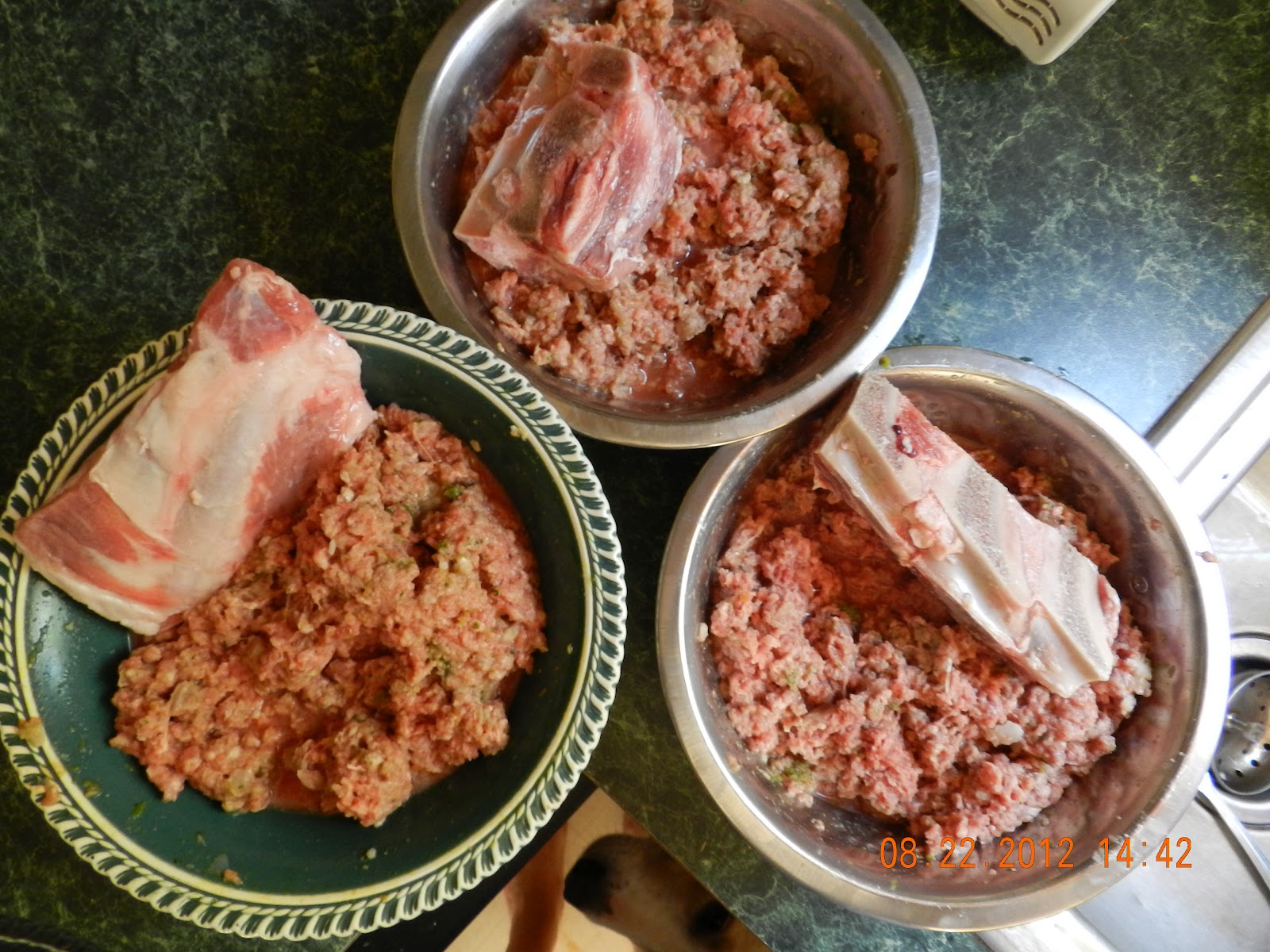 |
| Shown with beef bones |
 |
| My pack eating calmly near one another. I would not allow anything else! |
 |
| Cooter & Daisy are done in less than 2 minutes |

 |
| Jesse is a slow eater, but that is ok, he likes to savor the flavors! Jesse does not have to worry about eating fast, because the other dogs respect his space while eating. With multiple dogs this is a must have rule in my house! But if you leave your bowl & walk away, then it is fair game:) |
 |
| Daisy waiting on her bone |
 |
| Jesse waiting on his bone |
 |
| Cooter didnt want to come up on the deck, but he did sit when asked so I handed it down to him. |
 |
| Jesse took his bone out to the shade to gnaw on it. |
 |
| Cooter went right to work on his. |
 |
| Daisy enjoying her bone on the deck. I hope you can see how easy raw feeding can be, and enjoyable too! For the dog as well as the human that enjoys seeing their companion get so much enjoyment & stimulation from their food! |
Subscribe to:
Posts (Atom)